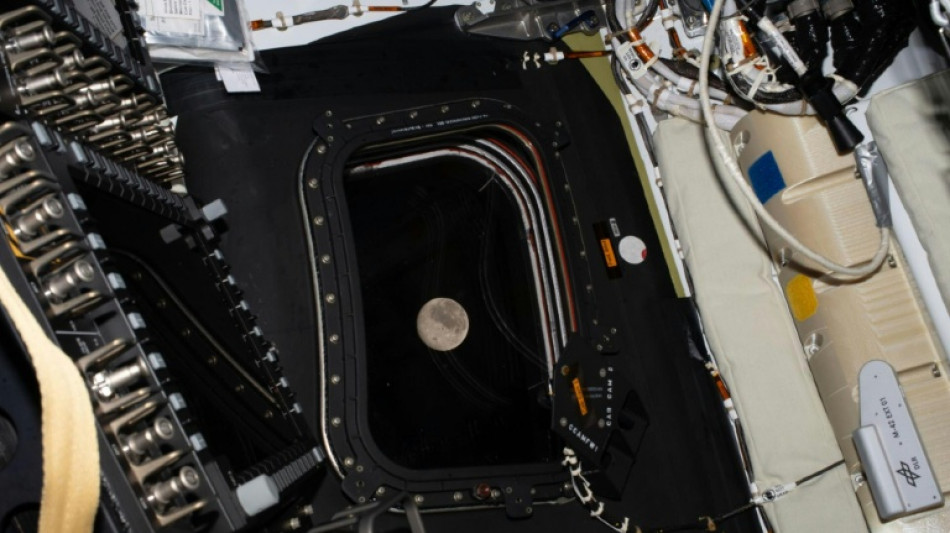
Artemis astronauts breaks space distance record / Photo: Handout - NASA/AFP
The four astronauts embarking on NASA's flyby of the Moon became on Monday the humans to travel furthest from our planet, as they began the lunar observation that is core to their mission.
The Artemis II team broke the distance record set by the 1970 Apollo 13 mission, which they are expected to surpass by 4,105 miles (6,606 kilometers) when they reach this journey's anticipated furthest distance from Earth -- 252,760 miles (406,778 kilometers) -- later today.
"For all humanity, you're pushing beyond that frontier," said Jenni Gibbons in Houston's mission control.
It was one of the voyage's most notable achievements yet.
Astronaut Jeremy Hansen said the moment was "to challenge this generation and the next, to make sure this record is not long-lived."
Now the crew have the more than six-hour task of observing and documenting the lunar surface, bringing human perspective to features of the Moon that we primarily know through photographs taken by robots.
Victor Glover detailed the "terminator" -- the Moon's boundary between night and day.
"Wow -- I wish I had some more time to just sit here and describe what I'm seeing," he said, before creating a vivid portrait for the scientists listening in from Earth.
"But the terminator right now is just fantastic. It is the most rugged that I've seen it from a lighting perspective."
Kelsey Young, the lead scientist for the Artemis II mission, responded with elation. "Oh my gosh, that was an amazing picture you just painted," she said.
"Those types of observations are things that humans are uniquely able to contribute, and you just really brought us along with you."
Fellow astronaut Christina Koch meanwhile offered a colorful rendering of lunar craters.
"What it really looks like is like a lampshade with tiny pinprick holes and the light shining through," she said. "They are so bright compared to the rest of the Moon."
- Expected comms loss -
The lunar flyby observation period will continue until approximately 9:20pm eastern (0120 GMT).
It will include an approximately 40-minute period when the crew is expected to lose communication with mission control in Houston.
"It'll be exciting in a slightly scary way, when they go behind the Moon," Derek Buzasi, a professor of astronomy and astrophysics at the University of Chicago, told AFP.
Near the end of their flyby, the astronauts will witness a solar eclipse, when the Sun will be behind the Moon.
The Orion capsule is zipping around the Moon -- the first crewed lunar flyby in more than 50 years -- before U-turning and heading back to Earth in a so-called "free-return trajectory," a return-trip that will take about four days.
Adding to the historic nature of the mission led by Reid Wiseman, the Artemis II crew includes several firsts.
Glover will be the first person of color to fly around the Moon, Koch will be the first woman, and Canadian Hansen the first non-American.
- Moon memorials -
Monday's celestial workday included a poignant moment just after the crew broke the distance regard, when they proposed designating two previously unnamed craters.
The first, they requested to name in honor of their spacecraft's nickname, "Integrity."
They offered a second name, "Carroll," for another crater, which they asked be named after the late wife of mission commander Reid Wiseman, who died of cancer.
"It's a bright spot on the Moon," said Hansen, his voice breaking with emotion. "And we would like to call it Carroll."
The astronauts embraced, and mission control in Houston held a moment of silence.
"Integrity and Carroll crater, loud and clear. Thank you," said Gibbons.
NASA said they would formally submit the name proposals to the International Astronomical Union, the body charged with naming celestial bodies and surface features.
S.Tamer--CdE