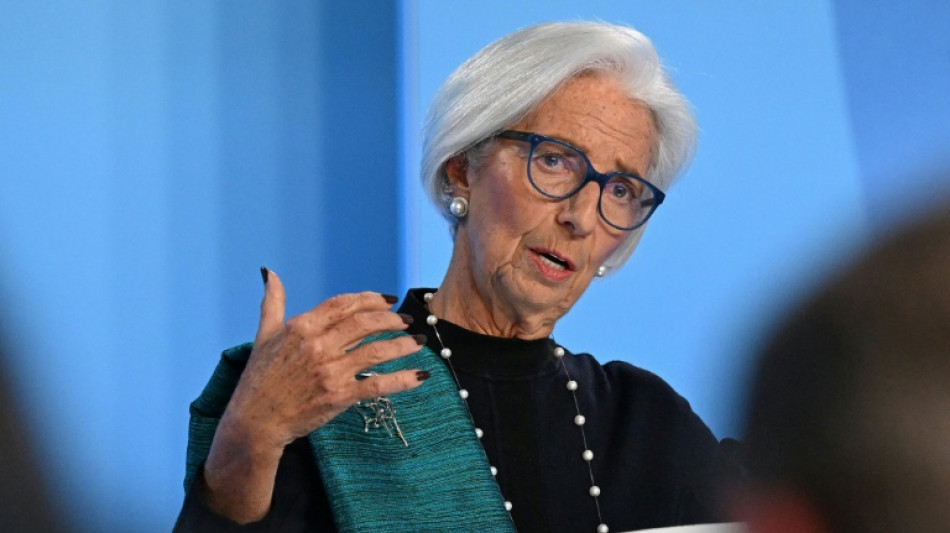
ECB holds rates as Lagarde stresses heightened uncertainty / Photo: Kirill KUDRYAVTSEV - AFP
The European Central Bank held interest rates steady Thursday for its fourth meeting in a row but was tight-lipped on the future rate path as it stressed lingering geopolitical uncertainty.
ECB President Christine Lagarde said tumult around the borders of Europe as well as the impacts of trade tensions meant it was impossible to issue guidance for the future.
"One thing that has not changed much at all and which, if anything, may have actually worsened is uncertainty," she told a press conference presenting the rate decision and improved growth forecasts.
"With the degree of uncertainty that we are facing, we simply cannot offer forward guidance."
The ECB nudged up its growth forecasts for the 20 countries that share the euro for 2026 and 2027 to 1.2 and 1.4 percent, up from 1.0 and 1.3 percent at its September projection.
Touching on the bumped-up growth forecasts, Lagarde said staff expected increased growth across the bloc thanks partly to higher investment as a result of spending on AI.
"We think that there is some change taking place in our economies," Lagarde said, pointing to business surveys.
"Both large corporates, but also SMEs (small and medium enterprises) as well, their investment based on the data that we collect, based on the surveys that we conduct, is largely attributable to the development of AI."
- 'All optionalities on the table' -
Investors were paying close attention to the new growth and inflation forecasts, seen by some as a possible barometer of the ECB's thinking when it came to possible future rate moves.
Governing Council member Isabel Schnabel -- widely considered a hawk who is particularly wary of inflation -- caused a stir earlier this month after telling Bloomberg that she was "rather comfortable" to see traders pencil in hikes, fuelling expectations of possible hikes.
Addressing a question on Schnabel's comment, Lagarde said that, amid heightened global uncertainty, "there was unanimous agreement around the table about the fact that all optionalities should be on the table".
Following a year-long series of cuts, the central bank for the eurozone has now kept its key deposit rate on hold at two percent since July, in contrast to the US Fed and Bank of England which have recently cut in response to signs of cooling economies.
Eurozone inflation has settled around the ECB's two-percent target in recent months and Europe has weathered US President Donald Trump's tariff onslaught better than initially feared, meaning there was little pressure for rates to move immediately.
Though the ECB raised growth and inflation forecasts for next year, it still sees inflation as coming in close but just under target for 2026 and 2027.
Analysts said there was little to prompt the ECB to move rates any time soon, though they were divided on the longer-term path.
"The new macroeconomic projections suggest there is little scope for further easing in the short term and that, rather, risks to the ECB interest rates are to the upside," EFG Asset Management economist GianLuigi Mandruzzato said.
But Capital Economics analyst Andrew Kenningham told AFP ahead of the meeting that he thought any improved forecasts were not necessarily a sign of the eurozone economy regaining real strength.
"Because of that we think the ECB is more likely to cut rates than to hike next year," he said.
L.Amro--CdE