Spain's First General Strike in 14 Years Targets Housing Crisis Ahead of Election
Spanish workers launched their first general strike in 14 years on Wednesday, protesting the nation's severe housing affordability crisis just weeks before a snap general election. Jointly organized by major unions UGT and CCOO, the walkout saw high participation in key industries despite stormy weather conditions.
Spanish workers initiated a nationwide general strike on Wednesday, establishing picket lines across the country to protest the deepening housing affordability crisis. The action, which occurred just weeks before a snap general election, marks the first time in 14 years that Spain’s two largest unions, UGT and CCOO, have jointly backed such a broad walkout alongside other labor organizations and tenants’ associations.
The strike was driven by anger over soaring rents and increasing evictions. Alicia del Rio, spokesperson for the Madrid Tenants’ Union, declared at the start of the midnight action: “We won’t stop until we transform this country’s housing model from top to bottom so that houses are for living instead of being at the service of the rentier minority.”
The urgency of the protest is underscored by data from Spain’s central bank, which estimates a current housing deficit of approximately 750,000 homes. This shortfall is projected to exceed one million units by 2028. As fewer citizens can afford to purchase property, demand for rentals has surged, placing immense pressure on the market. According to the Youth Council of Spain, the average monthly rental price of €1,176 (R21,674) consumes roughly 98.7% of a young person’s average monthly salary.
Participation in the strike varied significantly by sector. UGT and CCOO reported early turnout rates of 90% at ports and within the automotive industry, citing “total stoppages” at major factories including Volkswagen’s facility in Navarre and SEAT’s plant in Barcelona. The meat industry saw an 85% participation rate, while waste collection and energy sectors registered 82% and 75%, respectively. Conversely, involvement was lower in public services, with health care and social services at 38% and the postal service at 35%.
The walkout proceeded despite adverse weather conditions. Two storms, identified as Charles and Bruna, prompted the Spanish meteorological agency AEMET to issue alerts for 14 regions due to strong winds, rough seas, and heavy rain. Nevertheless, protesters gathered in major cities, with plans for afternoon marches proceeding under difficult conditions.
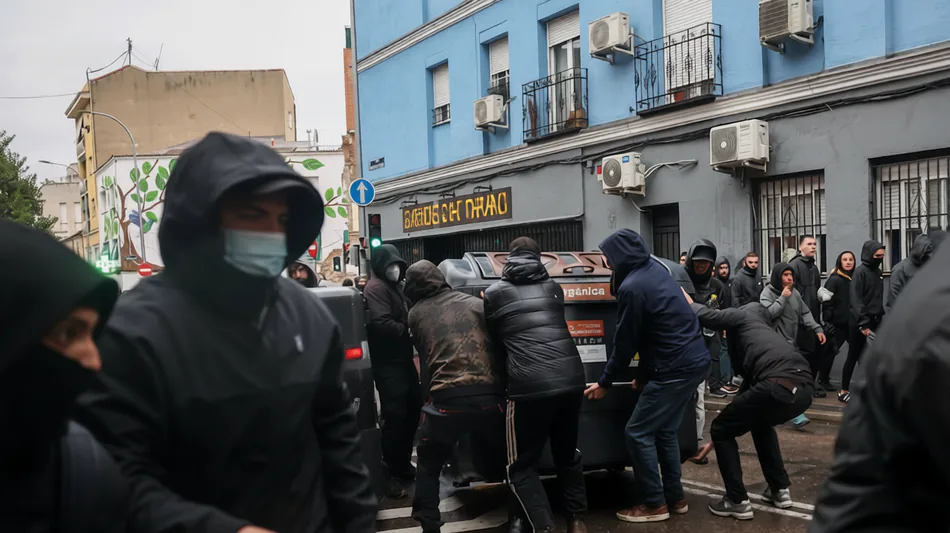
Tensions escalated at Madrid’s Mercamadrid wholesale market, where approximately 1,000 demonstrators assembled. CCOO’s Madrid branch reported on social media that police deployed pepper spray against picketers and arrested one individual, resulting in medical attention for 13 people. A police spokesperson confirmed the arrest but disputed the use of pepper spray at that specific site, though they acknowledged its use to disperse a separate picket line in the Carabanchel district.
The strike follows weeks of civil unrest triggered by the eviction and subsequent death of an 87-year-old woman in Madrid. These demonstrations, combined with parliament’s recent rejection of government decrees designed to curb evictions and limit rent pressures, prompted Prime Minister Pedro Sanchez to call for a general election on November 29.
The political context is complex. The government has largely attributed rising rents and insufficient housing supply to right-wing opposition parties that govern many regions and municipalities. Sanchez, whose Socialist Party currently trails in opinion polls, hopes to capitalize on voter resentment regarding housing to shift the political narrative away from corruption allegations involving his inner circle and a deadly train crash last month.
However, union leaders and many protesters hold the central government accountable for both the housing crisis and Spain’s second fatal train crash this year. On Tuesday, train drivers had already walked out to demand increased investment in maintenance and safety, causing widespread travel disruption prior to the broader general strike.
F.Walid--CdE