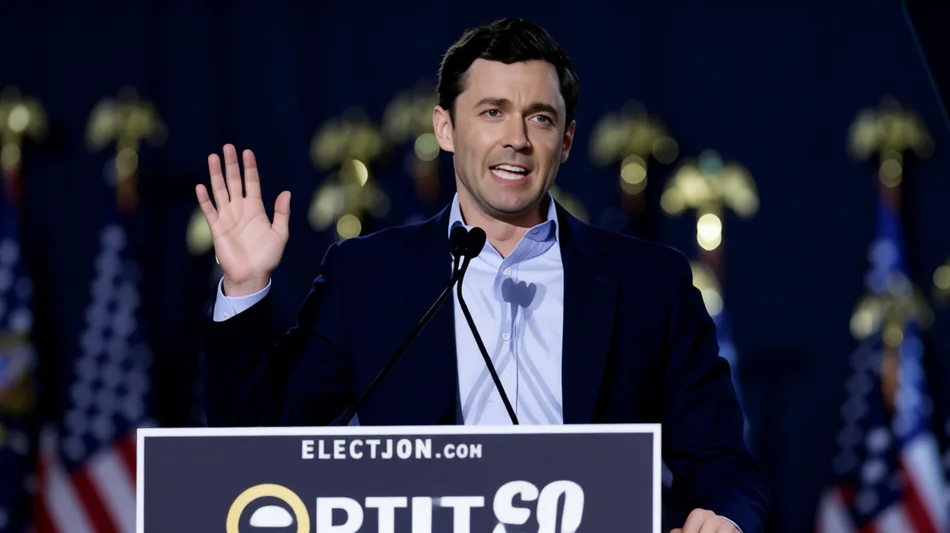
Ossoff and Talarico Emerge as Key Democratic Figures After 2026 Midterm Shift
Democratic victories in Georgia and Texas have reshaped the landscape of potential 2028 presidential candidates, elevating Jon Ossoff and James Talarico to national prominence. While Kamala Harris remains the polling leader, her support has declined, opening space for new contenders in a party seeking direction after recent electoral shifts.
Democratic victories in Georgia and Texas have fundamentally altered the early landscape of the 2028 U.S. presidential race, elevating Jon Ossoff and James Talarico to national prominence. While former Vice President Kamala Harris retains a lead in polling, her support has eroded, creating an opening for new contenders as the party seeks to define its direction following the 2026 midterm elections.
Ossoff secured re-election to the U.S. Senate in Georgia, reinforcing his status as a recognizable face of the Democratic generation. Talarico achieved a more statistically rare feat, winning a Texas congressional seat from Republican Ken Paxton. This victory marks the first time Democrats have won a statewide race in Texas in over thirty years.
The results have introduced fresh dynamics into the primary field. Ossoff has entered the polling data, currently holding 10.1% support according to PollCheck averages, a gain of 2.2 percentage points in the last month. Despite this rise, Ossoff has publicly stated he intends to serve his full Senate term and has not formally declared a presidential bid.
Talarico’s entry into the potential field is just beginning. At 37, the former teacher and Presbyterian seminarian built his campaign on anti-corruption, cost of living, and bridging political divides. His name does not yet appear consistently in national candidate polls, but his Texas victory has established him as a figure of national interest.
The broader Democratic polling landscape shows significant volatility. Harris leads with 23.6% support, but she has lost 5.1 percentage points over the past month. California Governor Gavin Newsom follows with 14.1%, also declining. Newsom’s active campaigning during the midterms consolidated his national profile but has not yet translated into polling growth.
Rising contenders include New York Representative Alexandria Ocasio-Cortez and former Transportation Secretary Pete Buttigieg. Ocasio-Cortez holds 12.1% support, up 2.6 points, while Buttigieg sits at 12.4%. Their ascent reflects internal party debates between progressive agendas and strategies to capture moderate and independent voters.
The midterms also strengthened governors who may enter the presidential race. Pennsylvania Governor Josh Shapiro won re-election, demonstrating his ability to win pivotal swing states. Kentucky Governor Andy Beshear, president of the Democratic Governors Association, highlighted his strategy’s success in expanding state-level control. Victories by Gina Hinojosa in Texas, Keisha Lance Bottoms in Georgia, Amy Acton in Ohio, and Rob Sand in Iowa further illustrate a shifting political geography.
On the Republican side, the race centers on succession from Donald Trump. Vice President JD Vance leads with 37.4% support. Secretary of State Marco Rubio has surged to 25%, gaining 7.3 points, positioning himself as a potential institutional continuity candidate. Donald Trump Jr. holds 10%, and Florida Governor Ron DeSantis has 7.9%.
Historical data complicates Vance’s path. While several incumbent vice presidents have secured their party’s nomination—including Richard Nixon, George H.W. Bush, Al Gore, and Kamala Harris—few have won the presidency. Only four incumbent vice presidents have been elected president, with George H.W. Bush in 1988 being the only one in the last 190 years.
The midterms have opened a new phase for both parties. No major Democratic contender has formally declared candidacy, but the early polling shifts indicate a competitive and evolving primary season ahead.
R.Saied--CdE