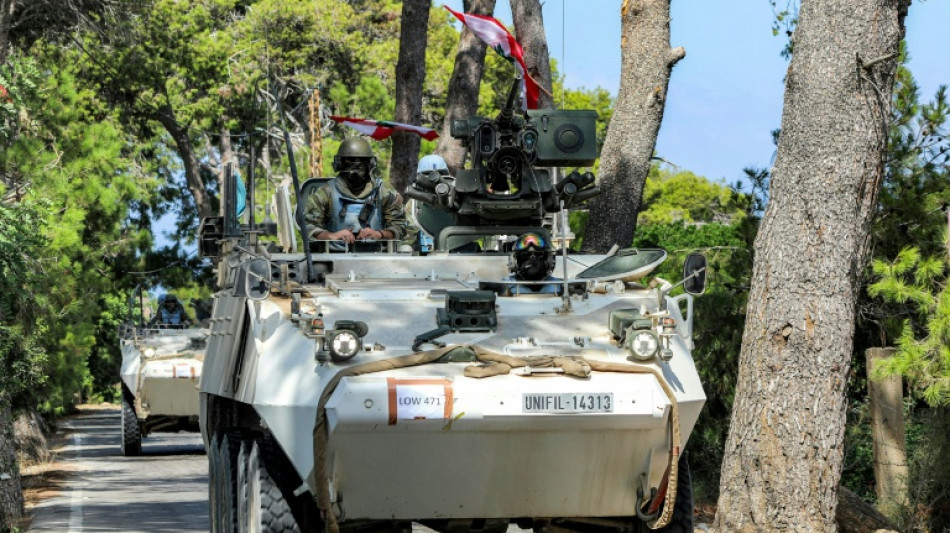
EU top diplomat says bloc in favour of UN Lebanon peacekeepers' extension / Photo: KAWANT HAJU - AFP
Visiting EU foreign policy chief Kaja Kallas told AFP on Thursday that the bloc favoured avoiding a security vacuum and extending a UN peacekeeping mandate in south Lebanon, where Israel invaded while fighting Hezbollah.
The EU's top diplomat also said that the bloc would soon be launching a training mission for the Lebanese army, calling it "a major upgrade in the security relationship" with the Mediterranean country.
Lebanon's cash-strapped, under-resourced military faces enormous challenges, including in completing its deployment to south Lebanon under a US-sponsored framework agreement reached between Israel and Lebanon in June.
"Our member states have been saying that there can't be any security vacuum in southern Lebanon, so everybody is worried about the UNIFIL mandate ending," she said in an interview during a visit to Lebanon where she met senior officials.
"It would be most welcomed if this mandate is extended, so that is the position of the member states," she added.
The United Nations Interim Force in Lebanon, which now counts some 7,500 personnel from nearly 50 countries, has been in place since 1978, although its presence has not prevented repeated outbreaks of conflict.
Under US pressure, the UN Security Council voted last year to end UNIFIL's mandate on December 31, 2026.
- 'Dangerous' -
But in March, Lebanese militant group Hezbollah drew the country into the broader Middle East war by attacking Israel, which responded with massive airstrikes and a ground invasion that Lebanon says have killed more than 4,300 people.
Israel now maintains troops in a self-declared "security zone" running around 10 kilometres (six miles) inside Lebanon along the border.
Violence has decreased since a ceasefire following a US-Iran understanding in June, and the US-sponsored Lebanon-Israel framework agreed later that month.
The framework deal involves the disarmament of Hezbollah, a gradual withdrawal of Israeli forces from Lebanon's south and the deployment of the Lebanese army to the region, starting in test areas known as "pilot zones", but the process has largely stalled.
Kallas said that under the deal, "there should be somebody who is verifying whether the parties are keeping to their agreements".
"So, as long as you don't have any kind of international force yet ready to do that... it's dangerous when one mission like UNIFIL ends and the other one has not started yet," she said.
Lebanese officials have repeatedly called for the mandate to be extended.
President Joseph Aoun's office said that he told Kallas that Lebanon is "counting on the support of the European Union to find an alternative formula" for after the UNIFIL mandate ends.
France and Italy, major contributors to UNIFIL, have previously said they are willing to set up a multinational coalition to succeed the force.
- EU training mission -
Kallas also said a planned EU training and advisory mission would soon be established, emphasising that it would not replace the peacekeepers.
On Monday, "we sit down with the EU foreign ministers to give this final push... to launch this mission", she said.
She expressed hope that the civilian-military mission, which will not only focus on south Lebanon, "would be ready already by the end of this year".
"The focus is on supporting the Lebanese Armed Forces, and supporting the Lebanese Internal Security Forces, in order to keep control of the country and security," she said.
"That means training, that means also working on the capabilities," she added.
"Lebanese sovereignty and territorial integrity is very important. So, it has to be the Lebanese government that is providing services and keeping control of the country," she added.
At a joint press conference with Lebanese Foreign Minister Youssef Raggi, Kallas emphasised that "Lebanon must have full control of its whole territory. That also means moving towards disarmament of Hezbollah".
The EU is a major source of assistance to Lebanon with Kallas noting that in September, the bloc announced 505 million euros ($615 million) in financial assistance until 2027, completing a one billion euro package announced in 2024.
Lebanon is also the third-largest beneficiary of its European Peace Facility fund, she added.
X.Emad--CdE