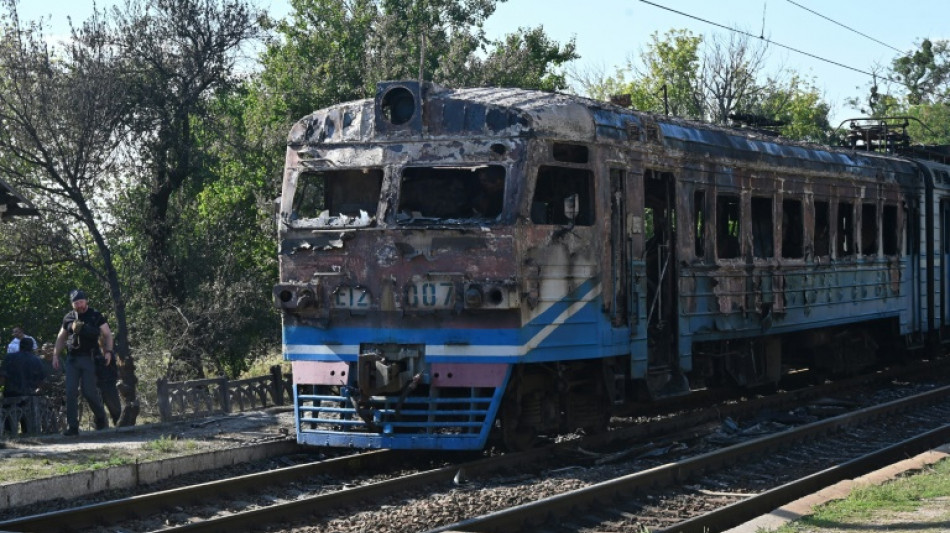
Wartime Ukraine works to keep its railways on track / Photo: SERGEY BOBOK - AFP
Oleksandr Pokotylo is the chief engineer at the Poltava Locomotive Repair Plant and it's his job to help keep Ukraine's trains running -- a difficult task when they are increasingly the target of Russian attacks.
Since Russia's full-scale invasion of Ukraine in February 2022, "at least 500 locomotives" have been destroyed by drones and missiles, he told AFP at the recent InnoTrans trade fair in the German capital, Berlin.
"Today in Ukraine, it's hard for us," he said. "But we are still working."
The head of Ukrainian Railways, Oleksandr Pertsovsky, earlier this month said there was a "virtually continuous campaign of strikes against the railway", with attacks getting worse each week.
Air links have been suspended since the start of the war, making trains a vital link not just for civilians and foreign diplomats but for soldiers, military equipment and freight cargo.
In Berlin, brochures for Pokotylo's company PTRZ proudly show rows of gleaming locomotives in the blue and yellow colours of the Ukrainian flag.
The lack of locomotives is a "huge problem" for the country, he added. "We're starting to repair older locomotives just to keep the system running."
- New orders -
French manufacturer Alstom is due to deliver some 55 new locomotives, funded by the European Bank for Reconstruction and Development and the World Bank, to Ukraine but not before next year.
The head of Alstom France, Frederic Wiscart, who was also in Berlin, told AFP that the Traxx Hauler locomotives dedicated to freight were being assembled at the Belfort plant in eastern France.
Production began in 2025, he added.
In the meantime, Ukraine's engineers are having to get mechanically creative in the workshop to keep the network on track, including the use of older stock.
Repairing damaged locomotives is difficult because parts are becoming harder to find, said Pokotylo.
Next to him at the Ukrainian railways companies stand in Berlin, Anna Shevtsiv, head of the equipment manufacturer Striy Avto in Lviv, said "life goes on" in the west of the country.
Striy Avto's 250 employees produce train seats and gangways, supplying most of the country's carriages on tender from Ukrainian Railways.
In her notebook, Shevtsiv stapled business cards from contacts made at the trade fair, including Polish and Latvian buyers, and even an American entrepreneur from Pennsylvania who wanted to source train seats.
Her two factories have been fitted with industrial-sized generators.
"Whenever there is a blackout we can still work, it does not stop," she added.
- 'War is our life now' -
Mariia Moroz said she is moving heaven and earth to try to save the railway industry in her home city of Kharkiv, in Ukraine's east, less than 30 kilometres (19 miles) from the Russian border.
The group of 26 firms that she works for aim to construct an underground factory able to withstand the drones and missiles that regularly rain down on the city.
"We have underground schools already, why not a plant?" she said.
Building it began last year and it is 10 percent complete, thanks to funding from Norway, but finance is lacking.
At the current rate, the underground facility could be up and running in five to 10 years, she estimated.
"My goal is to make people understand that they should not be scared... Kharkiv is always bombed. War is our life now... we create new technology, we create new ideas," she added.
I.Wael--CdE