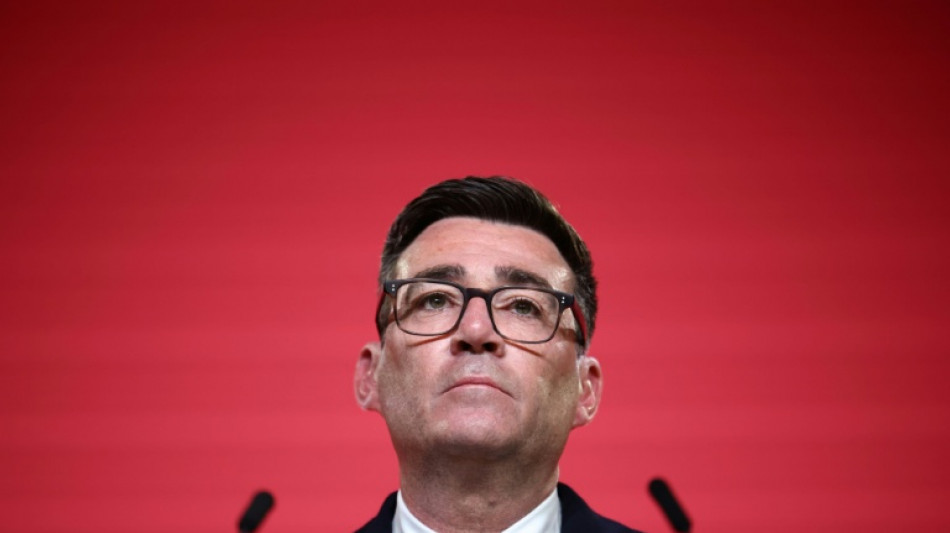
Burnham likely to steer steady ship on UK foreign policy / Photo: Henry NICHOLLS - POOL/AFP
Little known on the international stage, Andy Burnham is expected to broadly maintain Keir Starmer's position on major foreign policy issues as the UK's next prime minister.
This includes bolstering London's close ties with Kyiv and plans to strengthen relations with the European Union after the rancour of the Brexit years.
But in line with a growing clamour on the left wing of the Labour party angered by the Gaza conflict, he could take a tougher line on Israel.
Here are some of the foreign policy issues already crowding Burnham's in-tray:
- Israel and Gaza -
The sharpest departure in the new government's foreign policy could be over Israel.
The Guardian quoted Burnham as saying that many people thought the outgoing government "didn't get it right" in its response to Israel's military onslaught on Gaza following the October 2023 attack by Hamas militants.
"I am sorry about that. The response has too often not been good enough. We need to do better," the paper quoted him as saying earlier this month.
Since Starmer took office in July 2024, his Labour government has sanctioned Israeli ministers accused of fuelling settler violence in the occupied West Bank, suspended negotiations on a new free-trade deal with Israel and formally recognised a State of Palestine.
But defenders of the Palestinians say Starmer has not gone far enough and a poll indicated some voters have abandoned Labour for the Green Party, whose leader has accused Israel of committing genocide.
"We've got to do more to put pressure on the Israeli government," Burnham said.
"Yes, we have taken some important steps... But let's be honest, the UK was too slow to call for a ceasefire. And we must now do more to strengthen our approach."
Burnham said further sanctions should be considered and measures should be examined "to ban trade in goods with illegal settlements".
- Managing Trump -
Starmer gained a reputation as a "Trump whisperer" in the early days after Donald Trump returned to the White House for his second term as US president in January 2025.
But ties have hit a rocky patch despite attempts to woo the mercurial US leader.
Despite the much vaunted "special relationship" between the United States and Britain, Trump has repeatedly criticised the Labour government over defence spending, its reluctance to fully endorse US strikes on Iran and the future of the strategically important Chagos Islands, home to a joint UK-US military base.
Whether Trump will warm to Burnham remains unclear.
Asked recently about the former mayor of Manchester, the US leader said he did not know him well.
"I think he was the mayor of a city. I've heard he's very liberal," Trump said.
For his part, during his by-election campaign, Burnham warned voters that Britain risked drifting towards the "polarised, poisonous politics" of the United States, where "people in communities don't work together any more".
But he also wrote in the Times: "Our relationship with the US will remain critical as our most important defence and security ally."
He told former footballer Gary Lineker on his podcast that although he had not yet spoken to Trump he would deal with him in an "upfront" manner.
"It's about respecting the office... the US-UK relationship, but where you disagree ... do it in a way that is kind of meeting him where's he's at."
- Ukraine -
Support for Ukraine remains one of the rare issues which enjoys near-unanimous cross-party backing across British politics.
Burnham has vowed to maintain the strong backing for Kyiv begun under former Conservative premier Boris Johnson following Russia's 2022 invasion of Ukraine.
"British support for Ukraine will not falter," he wrote in the Times in early July.
Like Starmer, he sees that commitment as closely linked to Britain's role within NATO.
"Our commitment to NATO and the British nuclear deterrent capability will remain absolute," he said.
- Closer EU ties -
A longtime opponent of Brexit, Burnham has repeatedly signalled his desire to build closer ties between Britain and the European Union.
He wrote in the Times he wanted "an even closer relationship with countries across Europe" to "consolidate the progress made on the existing UK-EU negotiations".
He also pointed to cooperation on illegal migration, tackling terrorism and AI-driven disinformation.
He has ruled out rejoining the EU but said previously he hoped Britain would return to the 27-nation bloc within his lifetime.
K.Ehab--CdE