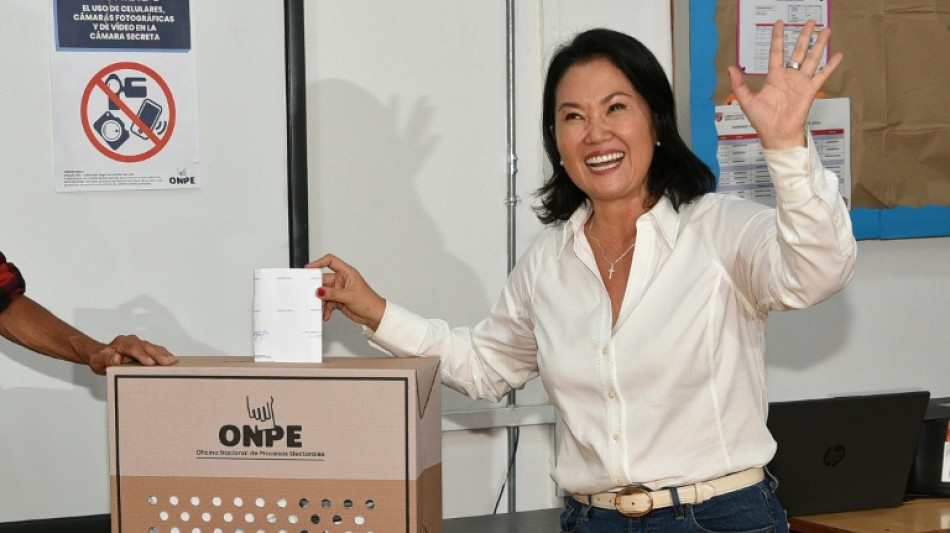
Keiko Fujimori: Peru's biggest political loser eyes election win / Photo: STRINGER - AFP/File
Peru's Keiko Fujimori is a perennial political loser. She has run for the nation's presidency three elections in a row -- and three times, she has lost.
But on this, her fourth attempt, the daughter of disgraced late president Alberto Fujimori may have her best chance at power.
She is riding a right‑wing wave that is sweeping Latin America.
The 51-year-old will face leftist Roberto Sanchez in Sunday's runoff, under the still‑divisive legacy of her father, who ruled Peru in the 1990s.
In a country that switches leaders at a frantic pace, with eight presidents since 2016, Fujimori hardly needs to campaign to be known. Her surname is recognized across the Andean nation.
"It is a brand that is well positioned, whether you like it or not," said political scientist Jorge Aragon.
This fourth attempt "may be the one that works," he said.
Poised and polished, with a sharp pantsuit and practiced smile, Fujimori looks like someone raised for politics.
A business administrator educated in the United States, she has served as a lawmaker and leads her party.
She became first lady at 19, after her mother publicly broke with Alberto Fujimori, and grew up alongside heads of state and foreign leaders.
- Dynasty -
Alberto Fujimori led Peru through the turbulent 1990s, crushing Maoist Shining Path rebels and taming hyperinflation.
But he was later disgraced, exiled and jailed for corruption and crimes against humanity.
For decades, the Fujimori name has helped and haunted Keiko, giving her instant recognition, loyal voters and deep political networks -- but also plenty of critics.
"I miss him," she told AFP in April. "But everywhere I go, people remind me of him and tell me anecdotes."
Millions of Peruvians hold darker memories of her father and refuse to vote for anyone bearing the Fujimori name, blocking her path to the presidency three times.
"In the last 25 years, we have been governed by anti‑Fujimori governments," she said, making a single exception for Alan Garcia.
"All the others focused on insults and generating hatred and division among Peruvians," she argues.
Critics blame her and her party for much of Peru's political instability, citing Fuerza Popular's heavy influence and deal‑making in Congress.
This is her first presidential campaign without her father, who died in 2024.
With crime now the top concern for voters, she has leaned into his legacy under a single word: "order."
"I believe Peruvians want a Fujimori," she said. "Here I am."
Those close to Fujimori describe her as persistent, disciplined and relentless.
"Every blow life has dealt her has not broken her, it has made her stronger than anyone could imagine," her vice‑presidential running mate Miki Torres told AFP.
She spent more than a year in pretrial detention while under investigation for alleged money laundering linked to the Odebrecht corruption scandal. The case remains unresolved.
Long seen as confrontational, Fujimori has tried to soften her image and present herself as more conciliatory.
"I have made mistakes," she said during a presidential debate on Sunday. "I learned from them and came back much stronger."
Keiko, whose name in Japanese means "blessed child," is widely known as "La China" -- a school nickname referencing her Asian features.
The divorced mother of two daughters, aged 18 and 16, once said that "learning to be a mother is harder than running for president."
Will she be remembered more than her father?
"The bar is high, and I hope to clear it," she told AFP.
L.Ramadan--CdE