Pakistan hosts Saudi, Turkey, Egypt for talks on Mideast war
/ Photo: - - Pakistan Foreign Ministry/AFP
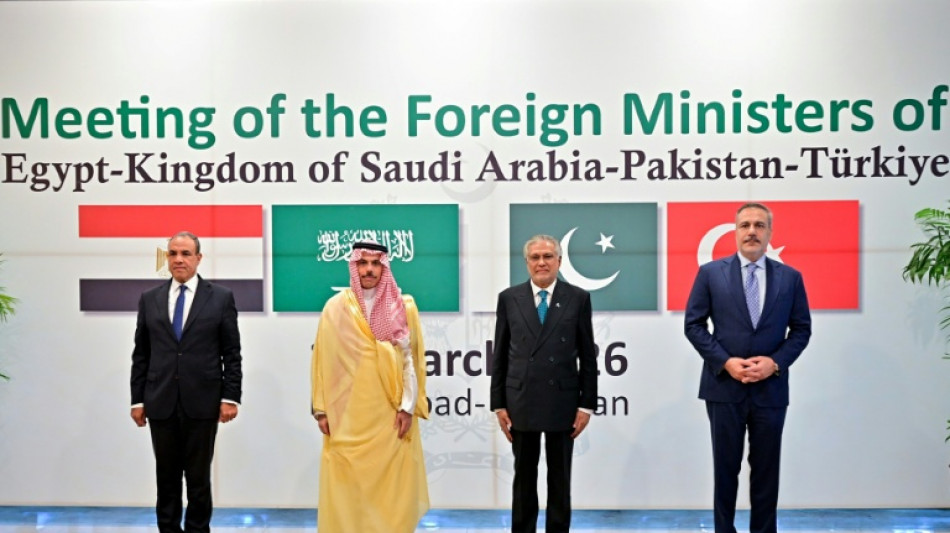
Pakistan, Saudi Arabia, Egypt and Turkey on Sunday held talks about trying to end the war in the Middle East, as Islamabad acts as a go-between between the United States and Iran.
The four-way meeting between the top diplomats of the Muslim nations lasted several hours in the Pakistani capital, Islamabad.
Pakistan has emerged as a key facilitator between Iran and the United States as their war drags on, relaying messages between the two sides.
It is seeking to capitalise on its longstanding links with Tehran and close contacts in the Gulf, and the personal rapport that Prime Minister Shehbaz Sharif and army chief Asim Munir have struck up with US President Donald Trump.
Foreign Minister Ishaq Dar said the talks, held under tight security at his ministry but without any US, Israeli or Iranian representation, came a "critical moment".
"Our candid and constructive discussions focus on the evolving regional situation and advancing peace and stability, while strengthening our partnership and deepening cooperation," he wrote on X.
Dar, who is also Pakistan's deputy prime minister, held separate bilateral talks with his counterparts -- Badr Abdelatty from Egypt, Hakan Fidan from Turkey, and Saudi Arabia's Faisal bin Farhan.
All three visitors also met Munir.
Pakistan and Saudi Arabia have a mutual defence pact and in another meeting, Sharif told Farhan that Riyadh had shown "remarkable restraint" in the crisis.
"While emphasising the Kingdom's leadership role in the Muslim Ummah (worldwide community), the Prime Minister stressed upon the need to forge unity within the Islamic countries at this critical time," a statement read.
- 'Event planner' -
Tehran has refused to admit to holding official talks with Washington but has passed a response to Trump's 15-point plan to end the war via Islamabad, according to an anonymous source cited by the Iranian Tasnim news agency.
Germany's Foreign Minister Johann Wadephul said on Friday he expected a direct US-Iran meeting in Pakistan "very soon", without revealing his source.
Shuja Nawaz, founder director of the South Asia Center at the Atlantic Council, said Pakistan had taken on a "challenging task" in trying to get Washington and Tehran to agree to talks.
"It could only do this with Saudi blessing," Nawaz, author of "The Battle for Pakistan: The Bitter US Friendship and a Tough Neighbourhood", told AFP.
"The real challenge for Pakistan is to bring together a single person in the White House who changes his mind frequently and an Iranian government that is debating whether to fight a long war or find an end to its economy being further devastated.
"Israeli autonomous decision-making will further complicate any Trump decision to claim victory and end a conflict that is hurting his popularity at home. Pakistan has limited leverage over both the US and Iran; none with Israel.
"Will it remain an event planner only?"
Sharif on Saturday said he had a detailed telephone conversation with Iranian President Masoud Pezeshkian lasting over one hour, detailing Pakistan's "ongoing diplomatic outreach".
Dar also said late Saturday that Iran had allowed 20 more Pakistani-flagged vessels -- or two ships daily -- to pass through the Strait of Hormuz, easing fears of an imminent fuel crisis.
"Dialogue, diplomacy, and such confidence-building measures are the only way forward," he wrote on X, tagging US Vice President JD Vance, Secretary of State Marco Rubio, envoy Steve Witkoff and Iran's Foreign Minister Abbas Araghchi.
E.Ibrahim--CdE