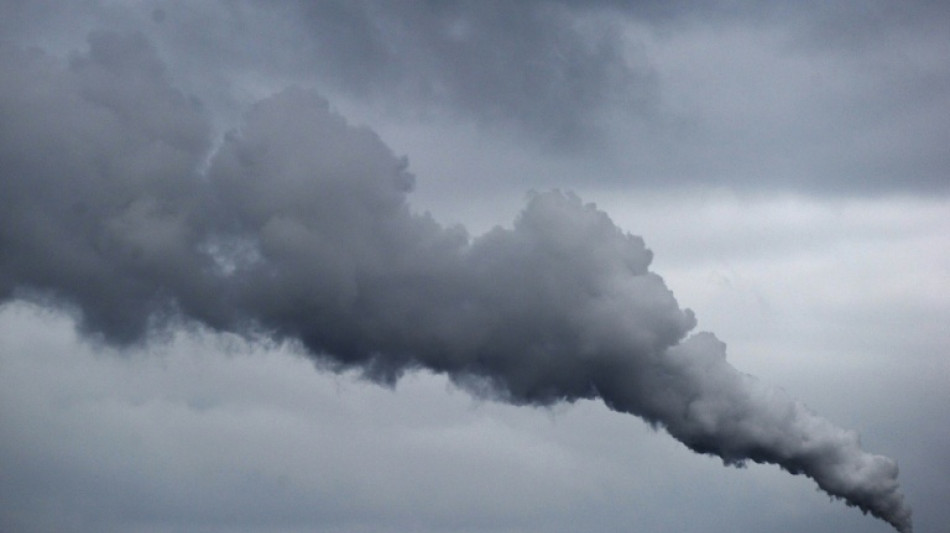
Italy challenges EU over key climate tool / Photo: JOHN MACDOUGALL - AFP/File
Italy is once again challenging the EU's green transition, pushing for an overhaul of the bloc's carbon trading scheme and changing the way the tool operates to try to cut electricity bills.
Prime Minister Giorgia Meloni called Thursday for the European Union's Emissions Trading System (ETS) -- which obliges heavy polluters to buy permits -- to be suspended pending a reform.
"Italy specifically wants to propose suspending the ETS system at this time of risk of a surge in energy prices," Meloni said, referring to the fallout from the Iran war.
Rome would "forcefully demand (its) suspension" at summit of EU leaders in two weeks, she said.
It is the latest effort by Rome to reshape the EU's green agenda, following a successful campaign to get Brussels to push back a landmark 2035 ban on new petrol and diesel cars.
Meloni, leader of the far-right Brothers of Italy party, has long railed at what she says are "green follies" imposed by Brussels.
Italian Industry Minister Adolfo Urso has also called for "a substantial overhaul" of the ETS.
Italy is now one of several countries in the bloc pushing for a greater flexibility on decarbonisation goals, particularly on energy, as its industries struggle with the Mediterranean nation's sky-high energy costs.
- 'Chilling effects' -
Rome also wants to lower energy bills by transferring the cost for carbon permits from gas-fired power plants to consumers.
It claims the move will cut costs because the price of electricity generated by different forms of energy -- even renewables -- is pegged to the most expensive, which is usually gas.
But many commentators are sceptical that meaningful savings from the measure, which is currently being debated in parliament, will be passed onto consumers.
Instead, analysts say, it risks rewarding dirty energy producers while reducing revenues at green energy companies, slowing Italy's already sluggish renewables rollout.
The potentially "chilling effects on renewable and energy storage investment in Italy are quite clear", Davide Panzeri, head of Italy-EU policy at climate think tank ECCO, told AFP.
"It would both make gas more competitive and signal a willingness by the Italian executive to upend a longstanding European decarbonisation policy," he said.
Brussels is preparing proposals for a reform of the bloc's 20-year-old flagship carbon market scheme later this year.
But European Commission chief Ursula von der Leyen is against any major changes, saying that high energy prices can only be alleviated by slashing fossil fuel use.
Italy's plan of "neutralising carbon costs is in contradiction with the ETS Directive and single market rules, so engagement on this with the Commission will be complex," Panzeri said.
He argues that it would also make Italy's competitive challenges "worse, as it incentivises reliance on gas".
European gas prices have surged dramatically since the United States and Israel launched their war against Iran, which responded with retaliatory strikes across the region.
- 'Changing the rules' -
Gas accounted for 47 percent of Italy's electricity production in 2025, the highest share in the EU after Ireland and Malta, according to research group Ember.
The country has not had nuclear power since 1990, though Meloni's government is working on a potential return.
Italy's renewable energy sector continues to grow despite bureaucratic hurdles: 49 percent of its electricity in 2025 came from renewables in 2025, up from 39 percent in 2015.
But the share of solar and wind still trails well behind countries like Greece, Spain, and the Netherlands.
"Affordable electricity for consumers comes from accelerating on the cheapest technologies, not by subsidising the priciest ones to make them slightly less expensive," Beatrice Petrovich, senior energy analyst at Ember, told AFP.
Italy's proposal to compensate operators of gas-fired plants for ETS permits also changes "the rules mid-game," Petrovich said.
That "hinders innovation and risks slowing investment in renewable capacity", she said.
Patrizio Donati, director of power producer Terrawatt, agreed the bill penalises renewables, and insisted the only way to "systematically lower energy prices" is to transition away from fossil fuels.
Q.Tarek--CdE