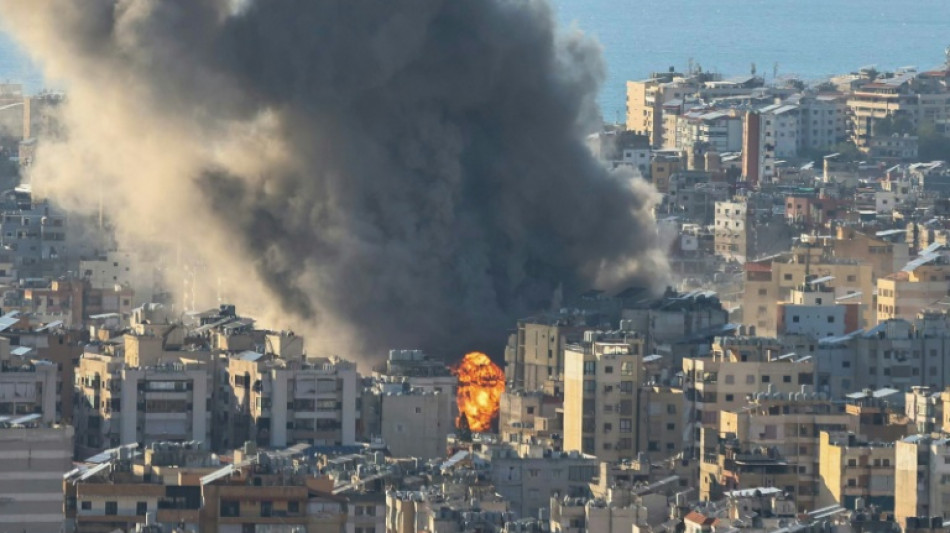
'Narrative war': disinformation surges as conflict roils Middle East / Photo: IBRAHIM AMRO - AFP
Recycled images, video game footage passed off as missile strikes, and AI-generated combat visuals: the US-Israeli assault on Iran has unleashed a torrent of online disinformation that analysts are calling a war of narratives.
Since US and Israeli strikes over the weekend ignited a regional conflict, a parallel information war has erupted, with supporters on both sides flooding social media with falsehoods that often spread faster than the facts on the ground.
AFP's fact-checkers have debunked a series of claims by pro-Iranian accounts posting old videos to exaggerate the damage from Tehran's missile strikes on Israel and Gulf states including the UAE and Saudi Arabia.
"There is definitely a narrative war unfolding online," Moustafa Ayad, from the Institute for Strategic Dialogue (ISD), told AFP.
"Whether it was to rationalize the strikes across the Gulf, or to trumpet Iranian military might in the face of the Israeli and US strikes, the goals seem to be wear down 'enemies.'"
On the other end of the divide, Iranian opposition outlets have pushed false narratives on X and Telegram blaming a missile strike on an Iranian girls' school on the Iranian government itself, researchers said.
ISD also cautioned that fake social media accounts have sprung up impersonating senior Iranian leadership.
Meanwhile, video game clips repurposed as Iranian missile strikes and AI-generated images of US warships being sunk, including the USS Abraham Lincoln, have garnered millions of views across major platforms.
Similar disinformation tactics have also been reported in other global conflicts including Ukraine and Gaza.
"It is really the speed and scale of these representations that is astounding, driving much of the online confusion of what has been targeted, or casualty counts for instance," said Ayad.
Such fabricated visuals -- portraying Iran as more menacing than evidence from the ground suggests -- have collectively garnered more than 21.9 million views on the Elon Musk-owned X alone, according to the disinformation watchdog NewsGuard.
- 'Fog of war' -
X on Tuesday announced it would suspend creators from its revenue sharing program for 90 days if they post AI-generated videos of armed conflicts without disclosing they were artificially made.
The policy change targets what the company described as a threat to information authenticity amid the ongoing war against Iran.
"During times of war, it is critical that people have access to authentic information on the ground," X's head of product Nikita Bier said, adding that current AI technologies make it "trivial to create content that can mislead people."
The new AI disclosure policy represents a notable pivot for a platform whose approach to content moderation has been heavily criticized since Musk completed his $44 billion acquisition of the site in October 2022.
"The fog of war is quickly becoming the slop of war as AI synthetic content creates infinite noise in information ecosystems," said Ari Abelson, co-founder of OpenOrigins, a media authenticity company that fights deepfakes.
"As we witness yet another immensely impactful global conflict unfolding in Iran, it's important for us to all understand how our media ecosystem is shifting."
In what could further stoke online chaos, a NewsGuard study showed that Google's reverse-image tool has produced inaccurate AI-generated summaries of fabricated and misleading visuals tied to the Middle East conflict.
This exposes a "significant weakness in a widely used system for verifying the authenticity of images," the watchdog said.
There was no immediate comment from Google.
The United States and Israel launched the attack on Saturday and quickly killed Iran's supreme leader, Ayatollah Ali Khamenei, two days after US envoys had been speaking to Iran in Geneva on a nuclear accord.
Since then, Iran has expanded its retaliatory missile and drone barrage across the Middle East, hitting on Tuesday a US consulate and base as the United States and Israel said they had pummeled key sites inside Tehran.
burs-ac/sla/jfx/ane
H.Zahran--CdE