Jihadist threat puts eastern Senegal on edge / Photo: Valentin RAKOVSKY, Sabrina BLANCHARD - AFP
Every time Senegalese mechanic Ibrahima Mbodj hears screeching tyres, a popping firecracker or even shattering glass, he fears another jihadist attack on the Malian border post near his village.
Senegal has remained unscathed by a series of jihadist attacks in Mali, but concern among residents is growing as the assaults inch closer to the border.
Gunfire early on July 1 awakened Mbodj and others in the Senegalese town of Kidira as the Malian village of Diboli, located directly across the border, came under attack.
The assault, which killed at least one civilian, was claimed by the Al-Qaeda-linked Group for the Support of Islam and Muslims, known by its Arabic acronym JNIM.
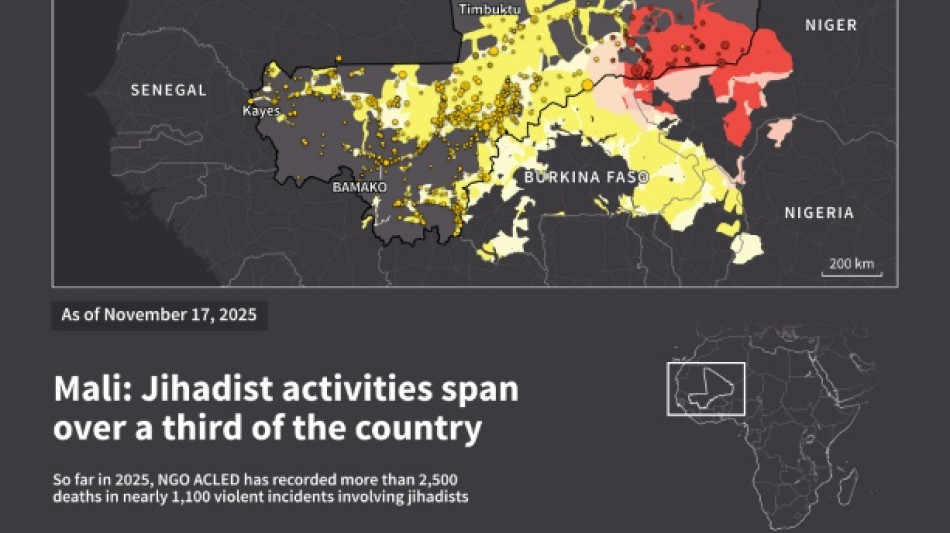
Although jihadist attacks were long confined to northern and central Mali, they have expanded to the west in recent months, including areas along the nearly 500-kilometre (310-mile) Mali-Senegal border, which is generally porous.
According to a 2025 study by the Timbuktu Institute think tank, JNIM has been seeking to establish a foothold in Senegal from the shared border region of southwestern Mali, where its members have increased activities "exponentially".
On the morning of the attack in Diboli, Mbodj was preparing for dawn prayers at home when he heard the deafening gunfire.
"It was very loud and lasted for several minutes. It was only afterwards that I learned it was a jihadist attack," he told AFP from inside his garage.
- 'Terrifying' -
Since then, anxiety has plagued Mbodj, who now personally picks up his three children from school and has drastically reduced his trips to Diboli, where he used to go regularly to buy used motorcycle parts.
Like him, many people interviewed by AFP said the event left a mark on them, while others seemed dismissive of the threat or expressed confidence in Senegal's military capabilities.
A melting pot of ethnicities located on one of the main routes between Dakar and Bamako, Kidira faces numerous security challenges relating to drug trafficking and illegal sex work.
Coumba lives just a few metres from the border crossing. Over the zinc fence around her mud-brick house, she can see the Malian flag flying above the border police station.
She felt as though the July attack took place in her own backyard. "It was terrifying," she told AFP.
She and her children now lock themselves in at night, only venturing out again after daybreak.
Aboubacry Diop, director of Kidira's community radio station, said the attack triggered widespread fear.
"The streets were practically empty in the days that followed," he said.
- Bulwarks -
Nearly nine months later, normal life has resumed but the attack remains on people's minds.
Amadou Massiga, who runs a hardware store in Kidira, does not think jihadists will ever attack the country.
"In terms of security, the jihadists know we have the means to fight them," he said, adding that he "sleeps soundly".
Mbodj disagrees, worrying that "these people are everywhere and can strike wherever they want".
Senegalese authorities have significantly reinforced security in the area, including an increased presence of soldiers and armoured vehicles that guard the bridge linking Mali and Senegal.
They have also strengthened border controls and implemented more frequent and regular patrols by members of an elite gendarmerie unit.
Senegal "has a military force powerful enough for jihadists to fear", a west African security source who spoke on condition of anonymity told AFP.
According to the Timbuktu Institute, eastern Senegal's social cohesion and religious moderation also form a strong bulwark against JNIM.
The think tank emphasised, however, that combatting jihadists will require increased awareness and implementation of development projects in the area, which faces stark poverty and inequality while lacking basic infrastructure.
In early February, Senegalese President Bassirou Diomaye Faye organised a three-day economic tour of the region, visiting several construction sites meant to "boost" the local economy.
He also expressed desire for a stronger "state presence" in the area.
Meanwhile Diop continuously broadcasts an unwavering message to the local population: cooperate with the security forces, especially if you see anything or anyone suspicious.
I.Wael--CdE