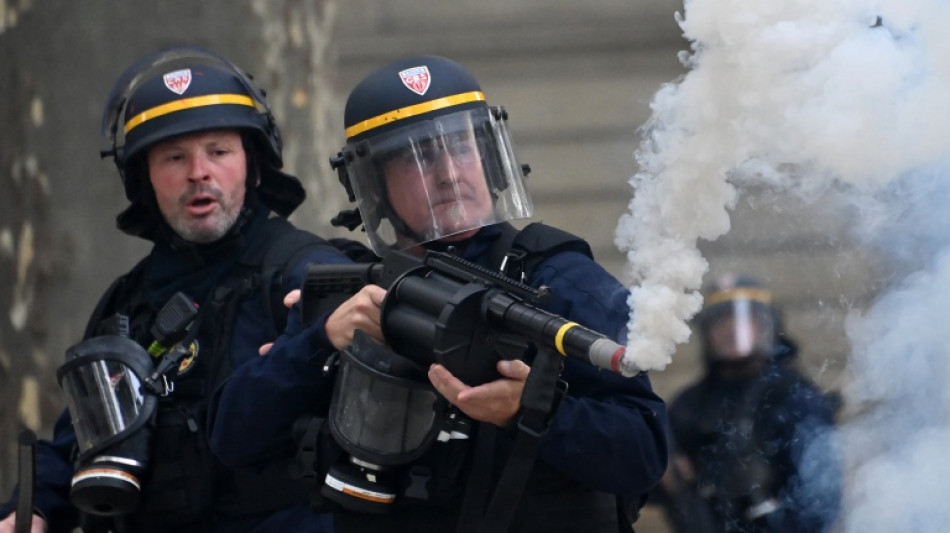
Clashes break out in Paris, other cities amid fresh protests / Photo: Sylvain THOMAS - AFP
Clashes broke out Saturday in Paris and other French cities amid demonstrations held a week after others that had degenerated into street violence and prompted a robust security backlash as President Emmanuel Macron seeks to restore order.
Police fired tear gas at protesters in the capital as well as in Marseille, Lyon, Lille, Bordeaux, Toulouse, Montpellier and Nantes, hours after Interior Minister Laurent Nunez had warned: "We will not tolerate any violence or any disturbance of public order."
Authorities had deployed 70,000 security forces across the country for the new marches, which were called, again, to protest the cost of living.
The rioting that occurred a week ago saw public buildings vandalised, hundreds of shops looted and 2,700 people arrested.
The street unrest on Saturday appeared less violent as night fell, but was nevertheless widespread, underscoring anger and discontent as France heads towards elections in six months to choose a successor to Macron, who is serving the last months of his maximum second term.
- Anger at Macron -
The demonstrations drew between 410,000 and 800,000 people across the country, according to different estimates by authorities and the organising CGT union.
The main Paris march had between 110,000 and 250,000 attendees, again according to those sources.
There was anger directed at Macron during the demonstrations over security measures seen as trampling the French right to protest.
Macron's government has ordered police to prevent protesters reaching city centres, where shops are concentrated, and in Paris and some other cities, curfews were imposed on certain urban zones.
The French president had blamed "ultra-left" groups who "want to bring down the republic" for the worst of last week's violence, and ordered non-union demonstrations be banned as "illegitimate".
His interior minister had said, before the main marches began, that 135 people had been arrested and weapons including metal balls, lead pellets, fireworks, slingshots, steel balls, improvised weapons, a katana sword and airsoft weapons had been confiscated.
Paris police later said 65 people were arrested in the capital, where many shops had boarded up windows out of fear of renewed looting and violence, and the Louvre and Musee d'Orsay museums had shut for the day.
- Clashes in Paris -
The main demonstration in the capital was pushed to its southeast rim under a last-minute order by authorities.
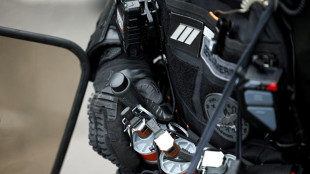
After it was held, largely calmly, clashes broke out as the crowd dispersed. AFP journalists saw police charge several times and vigorously use tear gas and batons against some, mostly young, protesters.
"The police started moving towards everyone, telling them to get down and back off. They were just taking people down, you know, beating protesters," one demonstrator bleeding from a baton blow to his face, who gave his first name as David, told AFP.
Paris's police said a water cannon was also used, and blamed "500 hooligans who are confronting law enforcement".
In the western city of Nantes, thousands of protesters broke through police lines to reach the city centre, an AFP journalist there witnessed.
Officers had used tear gas and a water cannon to try and stop them, some of whom threw projectiles and aimed fireworks in their direction.
In Lyon, police used tear gas to disperse around 1,000 people gathered in the south of the city.
"If they prohibit protests then that means we are heading more and more towards a regime that is fascist, that is dictatorial," said one 20-year-old protester there, who gave only his first name, Silem.
In Nice, a police water cannon pushed back protesters.
The Yellow Vests, who staged disruptive protests against Macron eight years ago, called for more demonstrations on October 31 for "the freedom to protest".
Far-left presidential candidate Jean-Luc Melenchon, who marched in the Paris rally, said Macron "is going to understand that this is going to repeat itself every week".
- Protest against Le Pen's party -
Adding to tensions, Marine Le Pen's far-right National Rally party opened a congress in Orleans to launch her campaign for a presidential election in six months.
Thousands of people chanting anti-fascist slogans marched against Le Pen, and Macron, a pro-business centrist who cannot stand again. "Macron resign. Le Pen in prison," the crowd yelled. Police put their numbers at 11,000 while organisers said 26,000 took part.
The unrest across France highlighted the febrile political atmosphere ahead of the vote, in which Le Pen leads in surveys.
Inflation in France, particularly affecting the cost of fuel, has surged since the start of the Middle East war in February.
Protests have also been taking place in Italy, Belgium, Spain and Portugal over different issues, yet with some overlap on inflation and education problems. Italy has mobilised 500 troops to Milan after street violence there.
B.Ali--CdE