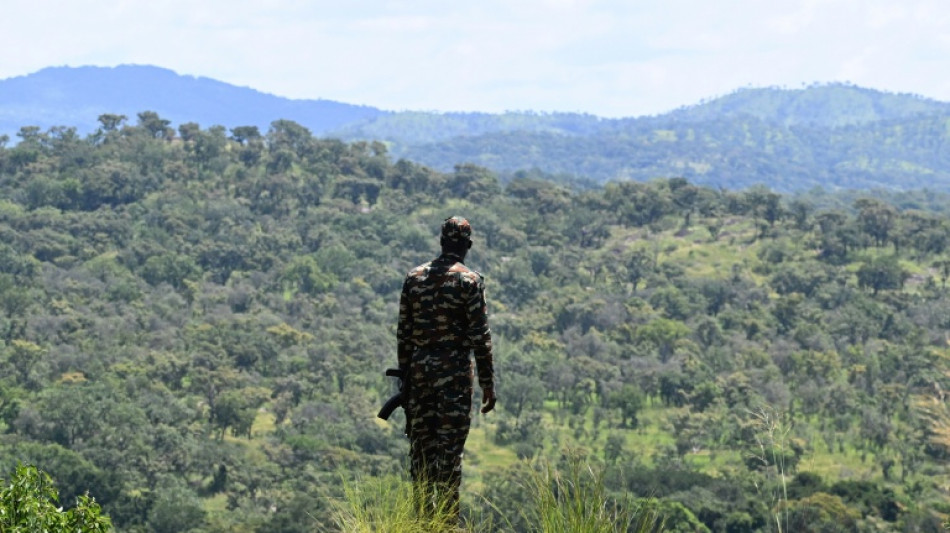
Ivory Coast clamps down on harmful illegal gold rush / Photo: Issouf SANOGO - AFP/File
A gaping hole in the ground dug by a hundred prospectors is all that is left of an illegal gold mine in Ivory Coast, one of many the state has vowed to eradicate within six months.
Near the central village of Baziafla, flanked by tall grass, the pit was excavated over several weeks with spades, pickaxes and crushers, before the miners were driven out of town by the local authorities.
As across much of west Africa, particularly Burkina Faso, Ghana and Mali, Ivory Coast is experiencing a boom in both legal and illegal artisanal gold mining, the latter of which the government has condemned as a "scourge".
Besides damaging the environment and the health of locals nearby, the profits from illegal mining help finance the jihadists and armed groups running rampant across the neighbouring Sahel region, according to experts.
The black market for irregularly mined gold represents millions of dollars that would have otherwise ended up in the Ivorian state's coffers.
The government toughened prison sentences this month to up to 20 years, stepped up surveillance measures and increased the number of brigades deployed in a bid to tackle the issue.
At the same time, the local authorities have intensified their warnings.
"To put an end to illegal gold mining, we have to stamp out all forms of complicity," local official Gueu Georges Gombagui told AFP.
His region of Marahoue is among those most pockmarked by artisanal pits, with around 15 mines identified, including the one near Baziafla.
- 'Nothing else to do' -
"From today, you will have to watch over your villages," Gombagui told around 100 local officials gathered in the village of Tibeita on a recent morning, urging them to "denounce" the prospectors and their accomplices.
By his side, the regional mining and geology director, Souleymane Sanogo, took aim at a climate of indulgence which allows irregular miners to thrive.
Among the culprits: owners letting their land, the youths delivering the fuel to run the mining machinery, but also "certain officials" in both Ivory Coast and abroad financing illegal mines to reap the profits.
Yet, on the ground, everyone denies having a hand in the trade.
When the prospectors are at work -- sometimes for months at a time -- "we do hear the noises", Baziafla's interim leader David You Bi Bolou said.
But "we don't have the strength necessary to go and interrupt them", he insisted.
Women are recruited to wash away the mud to reveal the nuggets of the precious metal, conceded Jacqueline Djangone, the head of the village women's association.
But she denies ever having done so herself.
Illegal prospecting "is an activity that young people get into because there's nothing else to do", acknowledged Michael Gohore Bi Vro, the deputy leader of Baziafla's youth organisation.
He, too, said he abstains from getting involved due to the damage illegal mining does to the land, especially as a result of the chemicals used for extracting gold.
"We can't grow anything anymore," he said.
The damage has even spread to Lake Kossou, Ivory Coast's largest, and an important source of water for the region.
After dredging up Kossou's sediments and using mercury to bind the gold into nuggets, the prospectors dump their toxic waste back in the lake, raged Gombagui, the prefect.
"The fish are no longer able to reproduce," he said.
- 'Suited everyone' -
Artisanal prospectors began mining gold illegally on a large scale in Ivory Coast in the 2000s, at a time when violent political crises weakened the state.
After returning to stability, the mining business has boomed.
Between 2012 and 2023, official gold production nearly quadrupled from 13 to 51 tonnes, while the country also boasts veins of iron, diamonds, nickel, manganese, bauxite, copper and coltan.
On top of the legal boom, the state has attempted to clamp down on clandestine prospecting.
Since 2021, nearly 4,500 people, 65 percent of them foreigners, were dragged before the courts on irregular mining charges, according to official statistics.
Over that time, the authorities have dismantled 8,500 illegal pits.
But critics say that only the small-time players ever get arrested, with the ringleaders most often getting off scot-free.
Around 200 kilometres (124 miles) from Baziafla in the commune of Bore, dozens of pits dug near the main road provide evidence of the recent presence of gold miners, chased out by the authorities at the beginning of September.
In one neighbourhood of the small town, many shacks where the prospectors lived and did business for more than a decade have also been destroyed.
"Gold mining suited everyone," one young resident said.
C.Mazen--CdE