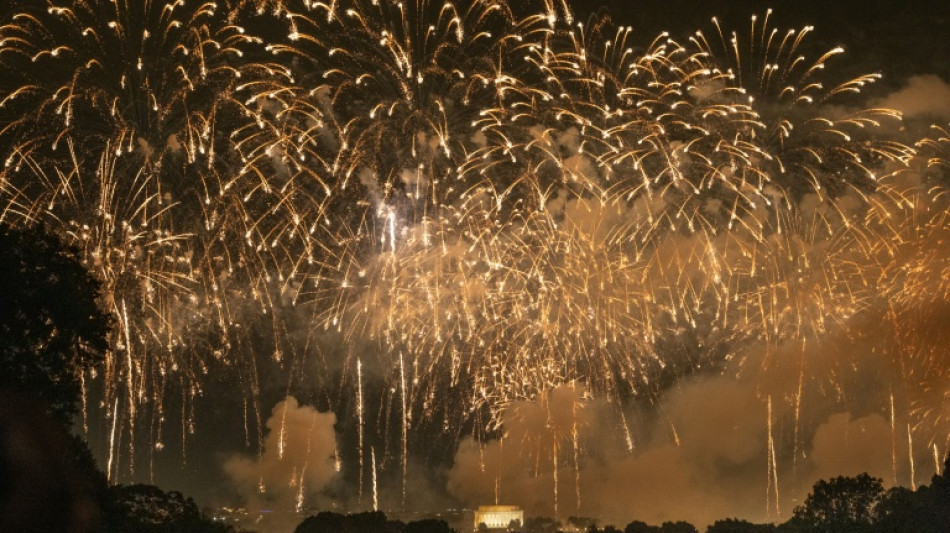
Record fireworks display choked Washington in toxic smoke / Photo: Ken Cedeno - AFP/File
The US capital Washington saw its worst air quality of the year over the July 4th weekend, as smoke from a massive fireworks display sent pollution soaring to levels considered very unhealthy for the entire public, data showed Monday.
Pyrotecnico, the company hired by the Trump administration's Freedom 250 organization, had set a goal of breaking a world record by launching 850,000 fireworks, with experts warning in advance that setting off such a great number over the course of just 40 minutes could be a recipe for disaster.
July 4 fell during a record-breaking heat wave that upended the parades, block parties and barbecues that traditionally mark Independence Day. The fireworks display on the National Mall was itself delayed until nearly midnight because of thunderstorms.
Washington's pollution monitors began registering spikes around 8pm on Saturday, signaling local fireworks displays. But levels of fine particulate matter spiked sharply during the main show, leaving people watching from the south with an obscured view as smoke came billowing their way.
Fine particle pollution -- defined as smoke and particles 2.5 micrometers in diameter that can penetrate deep into the lungs, causing acute injury but also long- term disease -- peaked at over 200 micrograms per cubic meter at one monitoring site, data reviewed by AFP showed.
"Code Purple" alerts, denoting air quality considered very unhealthy for everyone, not just at-risk groups, blanketed much of the city as well as the wider region, including neighboring Virginia and Maryland.
Asked for comment, Environmental Protection Agency press secretary Brigit Hirsch told AFP: "Fireworks are awesome and we hope everyone enjoyed the incredible shows in and around our nation's capital to celebrate 250 years of America."
Heavy rain helped clear the smoke, and conditions had returned to normal by around noon on Sunday.
"There were thunderstorms before, and pretty much during and after the fireworks, and we missed the worst of it," Russell Dickerson, an atmospheric scientist at the University of Maryland, told AFP.
"We dodged a bullet. It was very bad, but it could have been substantially worse. It was quite unsafe for everybody to be outside."
Ahead of the event, Pyrotecnico told AFP they were aiming to break the world record for the largest firework display, which was set on New Year's Day 2016 in the Philippines with around 810,000 fireworks.
A Guinness World Records spokesperson confirmed to AFP it had received an application from the current event and "it is currently being reviewed by our records specialists."
"At this stage, we are not able to confirm whether the record has been achieved. We will only be able to do so once the evidence has been submitted and fully reviewed by our Records team."
M.Bilal--CdE