'Holding our ground': Israel demolishes dozens of Bedouin homes / Photo: AHMAD GHARABLI - AFP
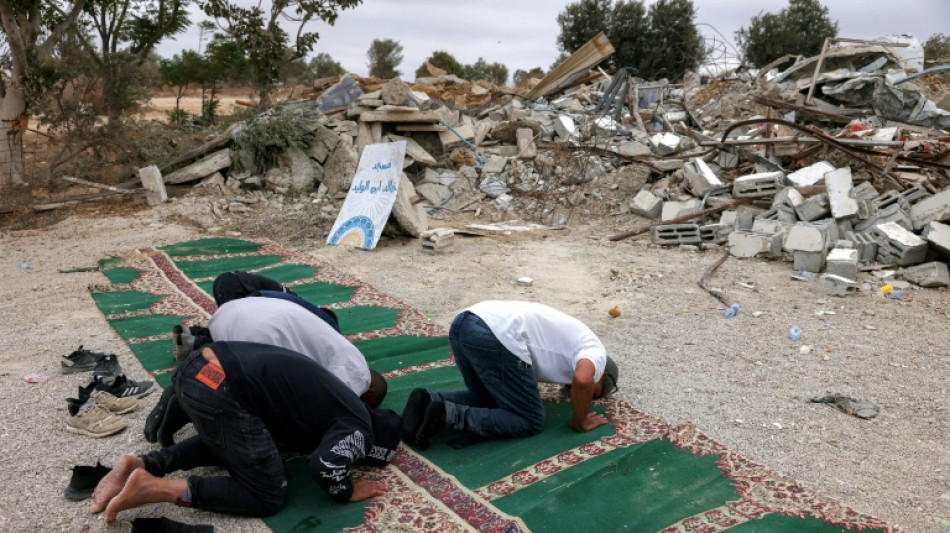
Under an overcast sky in southern Israel, Bedouin villagers wandered through the rubble of what used to be their homes, the latest to be demolished after being deemed illegal structures by Israeli authorities.
The residents of Al-Dahiya in the Negev desert say they have nowhere else to go after bulldozers destroyed around 80 structures housing some 400 people on Monday.
"When night falls, where are we supposed to sleep? Under the open sky, or by the light of the moon -- if there is a moon," said 65-year-old Muhammad Abu Wadi.
"God willing, it won't rain tonight."
Demolition orders issued by Israeli authorities plague Bedouin villages, threatening the traditionally semi-nomadic communities with forced eviction.
Roughly 300,000 Bedouins live in Israel's Negev, around 30 percent of whom reside in villages like Al-Dahiya which are not officially recognised by the government.
These unrecognised villages lack most basic services and are fighting the biggest battle to stay on the land.
The mayor of the nearby city of Rahat, Talal Al-Krenawi, told AFP that Israeli bulldozers demolished a mosque and 80 inhabited homes "where about 400 people lived, including 250 students between the ages of six and 18".
Adnan Abu Wadi, a father of four and resident of Al-Dahiya, said the village had received demolition orders six years ago.
"For four years we've been in and out of the courts and paid hundreds of thousands (of shekels) to cancel the order, but the court ruled a year ago in favour of demolition."
The residents' lawyer, Eli Ben Zaken, told AFP the destruction formed part of a wider effort by far-right national security minister Itamar Ben Gvir and diaspora minister Amichai Chikli to "significantly increase the number of demolitions".
"Nothing is going to be established on this land after the demolition. It is land empty of any project, and the residents have been living on it since before the establishment of the state," he added.
The Israeli police, which are under the ministerial responsibility of firebrand Ben Gvir, did not immediately respond to AFP's request for comment.
For Adnan Abu Wadi, the demolitions in his village were nothing more than an election stunt ahead of close-fought polls on October 27.
Ben Gvir "is trying to win as many voters as possible and please them with the criminal acts he is committing," Abu Wadi said.
- 'Displacement crisis' -
Before Israel's creation in 1948, the Negev -- or Naqab in Arabic -- was home to approximately 92,000 Bedouins.
But only 11,000 remained within Israel's borders after the 1948 Arab-Israeli War, according to Adalah, an advocacy group for Arab minorities in Israel.
Many of them refused to be resettled in the cities, and Bedouins have continued to be impoverished and marginalised in Israeli society ever since.
In March, Adalah said that the Negev's Bedouins were "facing an unprecedented crisis of forced displacement, mass evictions and home demolitions at the hands of the State of Israel".
"The current, imminent displacement crisis is driven by an explicit state policy of 'Judaisation', with the state's planning to establish over a dozen new Jewish towns" in the area, it added.
Far-right finance minister Bezalel Smotrich in August laid out his party's plan to dramatically increase the number of Jews living in the Negev and the Galilee -- another area with a large Arab-Israeli population.
"We will cancel the reckless plans in Arab communities, which have taken over land reserves and threaten Jewish settlement in the area," he said, pledging "one million additional Jews" in the areas and 40 new communities.
Abu Wadi said the court had offered Al-Dahiya's residents compensation in the form of a plot on which they could build new homes, but said the land was owned by other Bedouin families and therefore impossible to move to.
Lawyer Ben Zaken said the proposed site was unsuitable.
For 30-year-old Hisham Abu Wadi, the prospect of moving was out of the question.
"We are holding our ground and setting up tents like back in the day," he told AFP.
"Just as the Bedouins lived back in 1948."
F.Walid--CdE