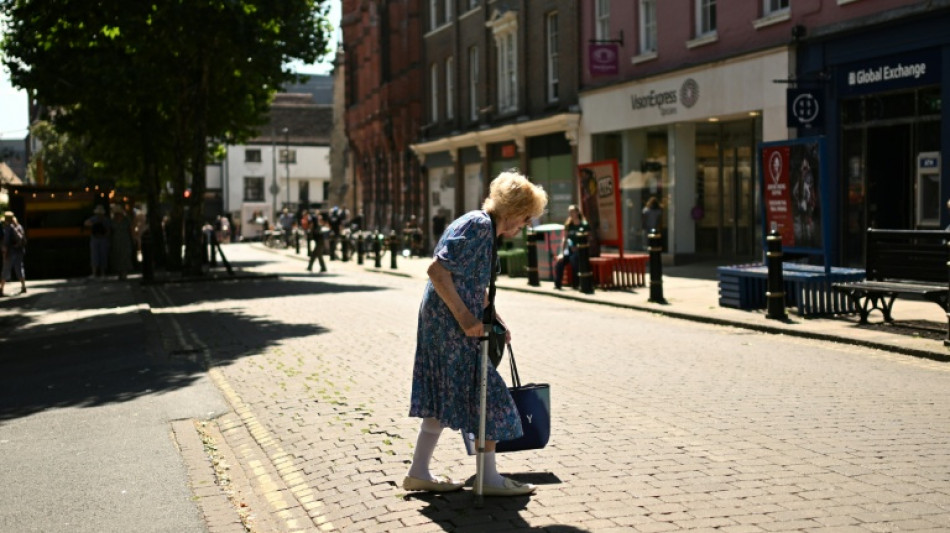
At-risk UK elderly bid to stay cool as heatwave bears down / Photo: Oli SCARFF - AFP
Fans in bedrooms, cold drinks, iced lollies under canopy cover in the garden: a UK care home has been doing what it can to keep vulnerable residents cool amid Europe's heatwave.
Kingsley Court, in the west London suburb Hayes, houses 85 residents, some as old as 100, and most of them living with dementia -- presenting unique challenges for staff.
As temperatures hovered near 36C on Wednesday afternoon, most of the seniors sat in the shade in the garden, as carers served up trays of fruit and cold drinks.
They had even set up a small inflatable pool for rubber duck fishing.
"I don't like (the heat), naturally, but if it happens we have to find means and ways to protect ourselves," said 97-year-old Lucine Nazikian.
The extreme temperatures sap the nonagenarian's appetite, making only light fare such as cucumber sandwiches and iced lollies, and the occasional ice cream, appealing.
"I don't go crazy," she noted.
Encouraging residents outside during the peak of a heatwave -- that has intensified in Britain over several days this week -- may seem surprising.
But the air circulates more outdoors, residents stay alert through interacting with each other and it is easier for staff to keep an eye on them there, according to Shiny Mathappan, the home's manager.
- 'Not normal' -
Inside, the seniors benefit from the building having been built relatively recently in 2010, with particular attention paid to ventilation, she noted.
Many such facilities, and other buildings across Britain, are far older and were built to retain heat during winters.
"Elderly residents are very vulnerable to the heat, mainly because their body will not be able to regulate the temperature as they used to," Mathappan explained.
"Dehydration is a high risk which is found in the elderly residents, and mainly happens because they don't feel thirsty (and) they like to sleep most of the time," she added.
Those with dementia at Kingsley Court are especially vulnerable.
"When they've got dementia, they forget to ask" for a drink, Mathappan said, noting staff had to be "proactive" offering up refreshments.
Charles Good, the home's oldest resident who turned 100 in the spring, was resting in an armchair in a communal room next to the garden, as a fan whirred nearby and a television hummed in the background.
"It's been three days now, I think it's only (getting) worse," the centenarian said, sighing and noting he felt more tired than usual.
"As the evening comes on, the air gets cooler. It revives me, you know?
"These summers are getting hotter, definitely."
Nazikian, sitting in an armchair in the garden, also voiced her concerns. "Nature is angry with us because we're destroying everything," she said.
"I am anxious because after all, I've got children and this is not normal."
- Yogurts, ice cream -
A study published by the London School of Hygiene & Tropical Medicine (LSHTM) in April reported "the increasing number and intensity of heatwaves in recent years has significantly impacted the health of care and nursing home residents in England".
Some 334,400 people live in such facilities in the country, which may be retirement homes, nursing facilities or, like Kingsley Court, a combination of both, according to official figures.
The UK's Office for National Statistics found nursing home deaths increased by 34.1 percent and residential care home deaths by 13 percent during a July 2022 heatwave when temperatures exceeded 40C in Britain for the first time.
Kingsley Court learned from that experience, installing hydration stations with water and fruit juice throughout the building.
The facility also offers each resident a fan for their room, and provides a steady supply of yogurts, ice creams and refreshing smoothies.
Shakoor Hajat, a LSHTM global environmental health professor and lead author of the study, noted the "passive cooling solutions" used at places like Kingsley Court can be "easier and more sustainable" alternatives to air conditioning (AC).
The solutions can also include "increasing shading around buildings, ensuring there is secure nighttime ventilation and using building materials known to reflect sunlight," she wrote.
Meanwhile AC -- which is not widely adopted in Britain where extreme temperatures were once rare -- is "expensive to install and run" and "contributes to emissions".
A.Karim--CdE