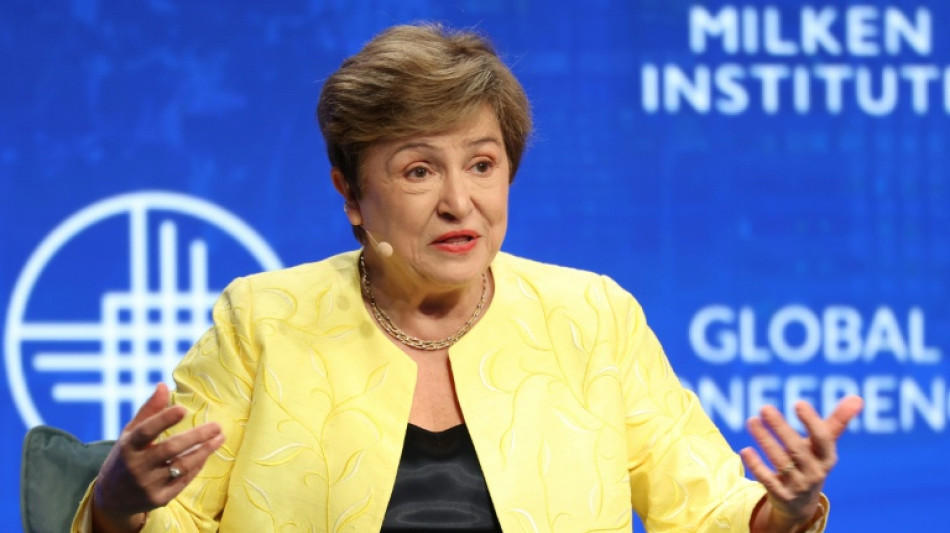
IMF chief warns energy recovery to take time after US-Iran ceasefire / Photo: Patrick T. Fallon - AFP
The International Monetary Fund chief on Monday welcomed the ceasefire agreement between the United States and Iran, but warned it would take time for energy and other supply disruptions to dissipate.
"As we have said before, much depends on the duration and intensity of the energy supply shock," Kristalina Georgieva wrote in a post on the Fund's website.
"The sooner it is resolved, the better -- especially as supply will take time to recover given the significant infrastructure damage -- and Sunday's ceasefire announcement is welcome."
The United States and Iran announced a deal on Sunday to end the Middle East war on all fronts and reopen the vital Strait of Hormuz, sparking relief after months of deadly violence and global economic chaos.
Georgieva also announced that the Fund would be releasing an update to its World Economic Outlook (WEO) -- which includes growth and inflation projections -- on July 8.
At its last WEO update in April, the Fund downgraded global growth projections due to the impact of the war.
Given uncertainty around the duration and intensity of the conflict, the IMF issued a range of scenarios, with the "severe" case showing global growth falling to two percent and inflation spiking to above six percent.
On Monday, Georgieva reiterated that there remained "a clear risk to global growth" from the conflict, and warned that there were "significant disparities" on its impacts.
"It is the countries that combine heavy reliance on energy imports with limited policy space that are especially hard-hit," she said, adding that the strain was visible in Africa.
She cited fuel shortages in Ethiopia, Malawi and Zambia, with high fuel prices threatening consumers in Lesotho, Rwanda and Tanzania.
Earlier this month, the Fund announced it was providing increased or faster access to funds to Ethiopia, The Gambia and Burkina Faso, and said it was in "accelerated" talks with Malawi for a new financial assistance program.
Emerging market economies in Asia have also been hard hit, with retail prices of gasoline increasing by 40 percent since the war began, she said.
Georgieva said the Fund was prepared to offer financial support to member countries, but that most governments had so far asked for policy guidance rather than cash bailouts.
She warned that oil-exporting countries in the Gulf had been badly hit by the war, and face "steep downward revisions to growth this year, with five out of eight countries seeing outright contractions."
L.Ramadan--CdE