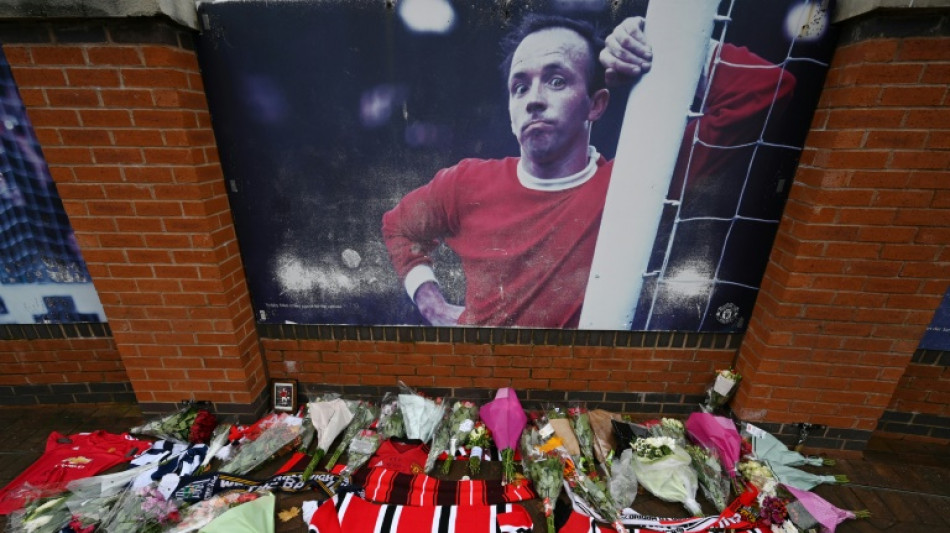
England World Cup winner Stiles died with brain injury, court told / Photo: Paul ELLIS - POOL/AFP
England World Cup winner Nobby Stiles died with a traumatic brain injury, a court heard Friday as a coroner ruled an inquest into his death must be held.
Stiles, 78, a former Manchester United footballer and 1966 World Cup winner, died with the injury, chronic traumatic encephalopathy (CTE).
This has been associated with head traumas, claimed to be from repeatedly heading a football.
Chris Morris, area coroner for Greater Manchester South, told Stockport Coroner's Court in northwest England that a brain expert had examined samples and medical records and due to the injury a full inquest would be required.
Norbert 'Nobby' Stiles, a renowned hard-tackling defensive midfielder was capped 28 times by England and made nearly 400 appearances for Manchester United.
He died in October 2020 following a long illness. His family, along with the relatives of several other late footballers, have since campaigned for the sport's govering bodies to do more to help ex-players cope with injuries they claim were caused during their playing days.
"On the basis of that cause of death, particularly the inclusion of a traumatic injury included in the cause of death, I’m satisfied an inquest is required into the sad death of Mr Stiles," Morris said.
The inquest will be held on July 15, at the same court.
Stiles's son John has previously said that football had "killed" his father.
He is among several former footballers and their families suing England's Football Association, the Football Association of Wales and the English Football League over claims they were "negligent and in breach of their duty of care" to the former players.
Lawyers for the former players and their families have previously said football authorities knew or should have known that repeatedly heading a ball in training and during matches was likely to cause brain injuries, and that the risks were known for decades.
But in March this year lawyers for the Football Association told the High Court it has "not been established by science" that heading a ball or "occasional" concussion can lead to permanent brain damage.
In January an inquest into the death of Gordon McQueen, 70, a former Leeds, Manchester United and Scotland defender found heading the ball was "likely" to have contributed to a brain injury which was a factor in his death.
McQueen was also diagnosed with chronic traumatic encephalopathy (CTE).
McQueen's TV presenter daughter Hayley McQueen said England’s 1966 World Cup winning team had now been "pretty much wiped out" by neurodegenerative disease, with hat-trick hero Geoff Hurst the last living member of the 11 that beat West Germany 4-2 at Wembley.
The FA is currently phasing out all heading in youth football up to Under-11 level.
V.Akram--CdE